
Future of Remote Work Quotes: Visionary Insights & Trends for 2025 & Beyond
The future of remote work isn’t just about where you log in; it’s a high-stakes evolution reshaping global economies and talent landscapes. This page is your definitive resource, offering authoritative, forward-thinking insights from industry leaders and researchers, cutting through the noise of typical WFH advice to reveal strategic truths for 2025 and beyond.
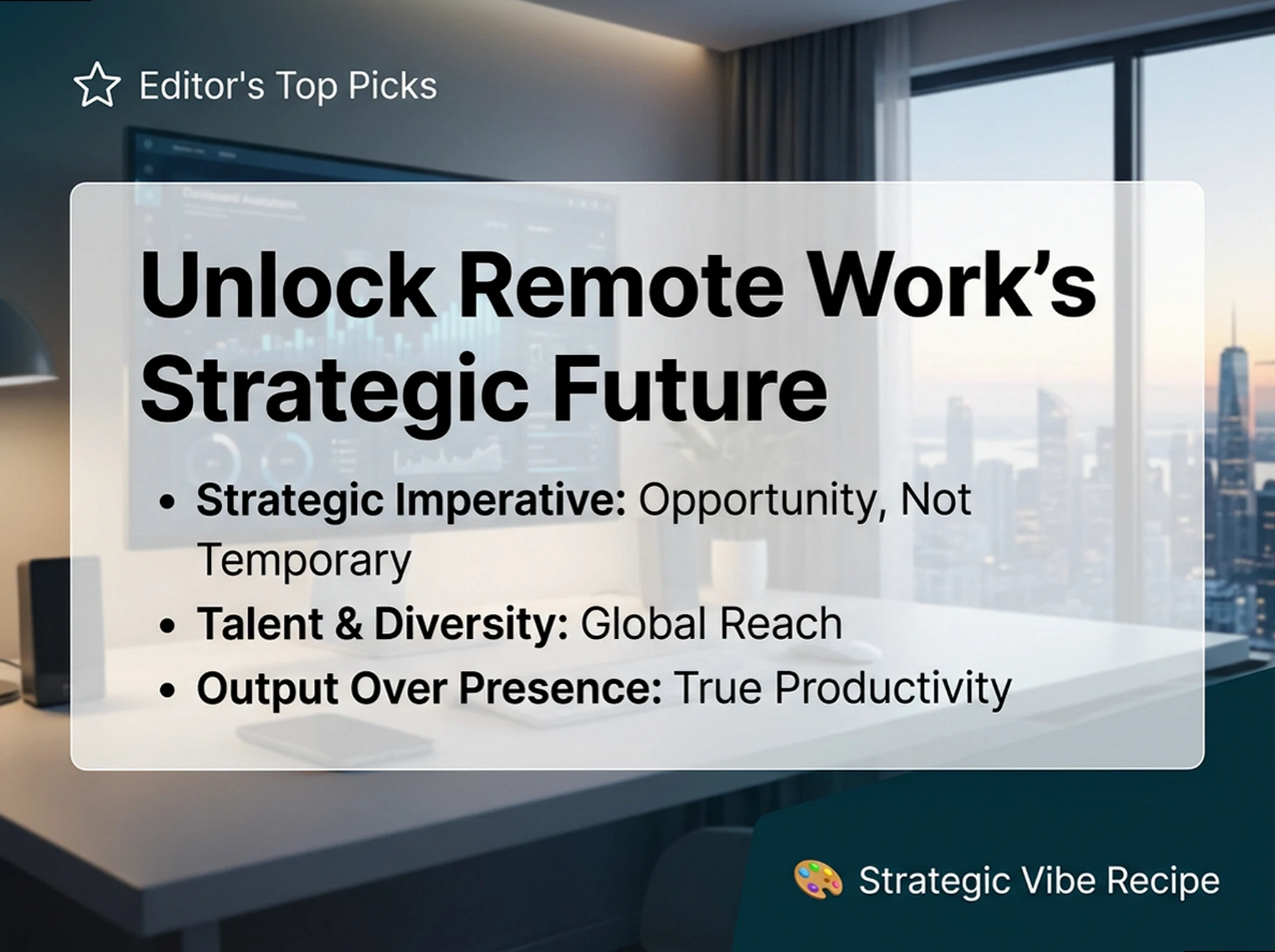
Editor’s Top Picks: The Future Is Now 🚀
Success in a hybrid work environment requires employers to move beyond viewing remote or hybrid environments as a temporary or short-term strategy and to treat it as an opportunity. ✨ – George Penn, VP at Gartner
I can’t tell you the number of CEOs I talked to who are thinking, ‘I have to solve the diversity challenge in my business, and remote work is one of the key tools…’ We have to let go of this very office-centric culture and incorporate people who are in a lot of geographies. 🌍 – Hayden Brown, CEO of Upwork
One of the secret benefits of using remote workers is that the work itself becomes the yardstick to judge someone’s performance. 🎯 – Jason Fried, Co-founder at Basecamp
Lean into the inherent flexibility of the remote format. Instead of monitoring team members obsessively, encourage their autonomy. They will gain confidence, agency, and efficiency. The result is a more productive team. (^▽^) – Tsedal Neeley, Harvard Business School professor
Now that companies have built the framework – and experienced the cost and time savings associated with it – there’s no real reason to turn back. 💡 – Mark Lobosco, VP of Talent Solutions at LinkedIn
Visionary Perspectives on Remote Work’s Evolution
These visionary quotes from business leaders and futurists offer a crucial glimpse into the long-term shifts in workplace culture, technology, and global talent acquisition. Pair these insights with your LinkedIn thought leadership posts or strategic presentations to spark essential dialogues and position your brand at the forefront of the work revolution.
Quotes on Remote Work’s Strategic Future & Business Impact
- People are more productive working at home than people would have expected. Some people thought that everything was just going to fall apart, and it hasn’t. And a lot of people are actually saying that they’re more productive now. 📈 – Mark Zuckerberg, CEO of Facebook
- We are seeing acceleration of the trend to democratize the workplace… digital technology has flattened hierarchies, with everyone connected and getting information at the same time, and so many channels for employee input and involvement in decision-making in real time. 🌐 – Diane Gherson, CHRO at IBM
- The future we envision for work allows for infinite virtual workspaces that will unlock social and economic opportunities for people regardless of barriers like physical location. It will take time to get there, and we continue to build toward this. 🚀 – Andrew Bosworth, VP Facebook Reality Labs
- Even if remote work turns out to be less productive on some metrics than others, reducing carbon-based emissions or the improving work-life balance could make up for it. 🌱 – Mark W. Johnson and Josh Suskewicz, Harvard Business Review
- As we’ve moved to virtual work, we haven’t just coped, we’ve actually thrived. We are more focused on the things that have the greatest impact for our customers, associates and the business. We are making quicker decisions and acting. Meetings are now more inclusive of people regardless of location, level or other differences. 🌟 – Suresh Kumar, CTO at Walmart
- Success in a hybrid work environment requires employers to move beyond viewing remote or hybrid environments as a temporary or short-term strategy and to treat it as an opportunity. 🔑 – George Penn, VP at Gartner
- Now that companies have built the framework – and experienced the cost and time savings associated with it – there’s no real reason to turn back. 🔄 – Mark Lobosco, VP of Talent Solutions at LinkedIn
- Technology… is dramatically changing the way people work, facilitating 24/7 collaboration with colleagues who are dispersed across time zones, countries, and continents. 🌍💻 – Michael Dell of Dell
- Remote work isn’t just a trend; it’s a revolution in the way we define and experience work. 💥 – Jan Jarko
- We need to take a more flexible approach to both the workplace and the work we do; one that provides us both the physical and cognitive space to harness the incredible power, insight and experience we offer, but focused not on the individual processes but instead on the overall outcomes our organizations are seeking to achieve. 🧠 – David Coplin
- If you’re running a centralized company and then you try to attach remote work as an appendage, that usually doesn’t work. But if you design a company to function under the assumption that people won’t be in the same office, then remote work is perfectly doable. ( ´ ▽ ` )ノ – Goncalo Silva, CTO of Doist
- Telecommuting, one of many forms of work-life flexibility, should no longer be viewed as a nice-to-have, optional perk mostly used by working moms. These common stereotypes don’t match reality—allowing employees to work remotely is a core business strategy today… We need to de-parent, de-gender, and de-age the perception of the flexible worker. 💪 – Cali Williams Yost, CEO and Founder of Flex+Strategy Group
- Companies with a powerful and intentional virtual culture will have an incredible advantage going forward. 🤝 – Meghan M. Biro, Founder and CEO of TalentCulture
- Employers, managers, and employees will share ownership of hybrid work decisions, with a common expectation that employees can switch locations dynamically and without a fixed or rigid pattern. Where, and when, work gets done will be determined by what makes the most sense to drive the highest levels of productivity and engagement. 📊 – George Penn, Managing VP at Gartner
- The only thing that matters is the output of your team. By releasing control over when and where someone works and only focusing on the results, you will create space for your team to get creative, find new ways of doing things quicker, and build a stronger culture. 💡 – Mitko Karshovski, Founder at Remote Insider
- We need better ways to measure performance, [and] we need better tools for managers to know what good performance looks like so you can trust that people are doing great work, even if you don’t happen to sit in the same room with them every day. ✅ – Adam Grant, #1 New York Times bestselling author
- If you’re not constrained by the traditional office work approach, you can benefit by going remote. There are cost savings, and then, of course, a huge sense of freedom when working remotely. 🕊️ – Erik Allebest, CEO of Chess.com
- Workplace flexibility is a bridge to takes us to fundamentally better ways of working. Work is something that we do, not somewhere we go. 🌉 – Laurel Farrer, Founder and CEO of Distribute Consulting
- Do you want to access talent everywhere, or just in specific markets? If the answer is everywhere, you need to be at least open to the possibility of remote work. 🗺️ – Katie Burke, Chief People Officer at Hubspot
- If you are not limited by a specific office location, you can look anywhere in the country or anywhere on the globe. 🌐 – Nicole McCabe, VP at SAP
- This trend [of remote/hybrid work] could easily continue for a decade or longer as the younger workforce becomes more entrenched, potentially clashing with the viewpoints of older managerial generations. ( ̄ー ̄)b – Hiroki Sayama, Distinguished Professor of Systems Science and Industrial Engineering
- Providing remote or hybrid options helps organizations retain talent, especially in industries such as law firms or technology, where employees value autonomy a lot. 🌟 – Yu Wang, School of Management doctoral student
- Allowing companies to access a broader client base without needing to build new physical offices could also help them unlock new market opportunities while avoiding increasing costs. 💰 – Yu Wang, School of Management doctoral student
- Remote work has transformed from a pandemic-driven necessity into a fundamental part of modern business operations, redefining how organizations function, attract talent, and stay competitive. 📈 – Splashtop Blog
- The globalization [of the workforce] not only enhances innovation but also provides cost-saving opportunities by tapping into talent markets with varying wage structures. 💸 – Splashtop Blog

Addressing the Challenges & Building Resilience in Distributed Teams
Remote and hybrid teams face critical challenges: maintaining culture, ensuring communication clarity, and preventing burnout. The quotes below offer practical solutions and a mindset for resilience. Use them for internal communications, team meeting icebreakers, or to frame discussions around building a robust, future-ready distributed workforce.
Overcoming Remote Work Obstacles: Communication, Trust & Culture
- Working from home makes it much harder to delineate work time from personal time. I encourage all of our employees to have a disciplined schedule for when you will work, and when you will not, and to stick to that schedule. ⏰ – Dan Springer, CEO of DocuSign
- The most important keys to remote work at a startup have been weekly stand-ups. At Hive, we all get on Zoom once a week to chat and give shoutouts to the team. We also have regular 1:1s with video on. Having your video on totally changes the tone of a meeting and is critical for a startup. 📹 – John Furneaux, CEO of Hive
- In teamwork, silence isn’t golden, it’s deadly. 🤫 – Mark Sanborn, author
- Work-life balance is not just a buzzy, self-help term that real business people laugh at. You need it. ⚖️ – Stephanie Ruhle, journalist
- Remote work is this incredible invitation to really get good at building inclusive cultures. 🤝 – Shane Metcalfe of 15Five
- You can never over-communicate enough as a leader at a company, but at a remote company, nothing could be truer. 🗣️ – Claire Lew of Know Your Team
- There’s a great opportunity to begin to explore how we create an environment that is safe for people who want to have conversations about flexibility, who want to be flexible, vs. fighting that change. 🗣️ – Peter Yobo of PwC
- We like to give people the freedom to work where they want, safe in the knowledge that they have the drive and expertise to perform excellently, whether they’re at their desk or in their kitchen. Yours truly has never worked out of an office, and never will. 🏡 – Sir Richard Branson, Virgin America
- When you’re at home, rig up a good video setup with nice headphones, a quality microphone, and lighting. And devote blocks of time to video calls. 🎧💡 – Rory Sutherland of Ogilvy
- Trust is knowing that when a team member pushes you, they are doing it because they care about the team. (。◕‿◕。) – Patrick Lencioni
- We think, mistakenly, that success is the result of the amount of time we put in at work, instead of the quality of time we put in. 🕰️ – Ariana Huffington, The Huffington Post
- Build a plan to create a location-inclusive mindset as part of your DEI strategy…Visually map out the geographic anatomy of the team so that you can see which team members are in each location and time zone, and which are fully remote and which are hybrid. 🗺️ – Sacha Connor, Founder and CEO at Virtual Work Insider
- The office cubicle has given way to the world as your workspace – a global stage for innovation and collaboration. 🌐 – Jan Jarko
- To start building your remote culture, establish and share some basic rules. The first and most important rule is mutual trust between the company and its workers. The rules after that? As few as possible. 🙏 – Larry English, author of *Office Optional*
- Successfully working from home is a skill, just like programming, designing or writing. It takes time and commitment to develop that skill, and the traditional office culture doesn’t give us any reason to do that. 🛠️ – Alex Turnbull, Founder and CEO of Groove
- You can thrive and excel when you’re working remotely, if you adopt the mindset, habits, and tech tools of professionals who are even more productive outside the office: Learn to think like a ‘business of one,’ and that entrepreneurial mindset will transform your experience of remote work. 🚀 – Robert C. Pozen, Author of *Remote, Inc.*
- I wanted to work around my life rather than live around my work. 💖 – Lisette Sutherland, author of *Work Together Anywhere*
- Think about this way: if you can create a three-hour chunk of non-distracted work time in your house, you will be more productive than the average office worker. 집중! – Sharon Koifman, Founder and President at DistantJob
- Adhering to a stable daily routine fosters consistency and productivity. However, he also emphasizes the importance of embracing flexibility to tackle unexpected challenges that arise. (ง •̀_•́)ง – Michael Erasmus, Former Data Science Manager at Buffer
- There are things you can accomplish more effectively online and things that work better in person, so instead of viewing it as one option being better than the other, managers would benefit by looking at which option is best suited to meet the objective. 🎯 – Hiroki Sayama, Distinguished Professor, Binghamton University
- Hybrid models are probably the most effective, because you still have some people in the same room to directly engage with others in a conversation. 🤝 – Chou-Yu (Joey) Tsai, Osterhout Associate Professor of Entrepreneurship
- What we find in that meta-analysis is that telecommuting has largely beneficial effects and very little downside. 📈 – Ravi S. Gajendran, Associate Professor, FIU Business
- If you expect employees to all act like leaders, if you expect them to think like owners and to take ownership and responsibility, then mandating cameras-on kind of defeats that principle. 🚫 – Ravi S. Gajendran, Associate Professor, FIU Business
- To make working from home a sustainable strategic practice, organizations need to go beyond simply ‘allowing’ employees to work remotely by also providing strong internal management support. 🏗️ – Yu Wang, School of Management doctoral student
- Cybersecurity Takes Center Stage: As remote work grows, so do the associated cybersecurity risks. By 2026, businesses will place even greater emphasis on secure systems and practices to combat rising threats in remote work environments. 🔒 – Splashtop Blog
Create a poll on LinkedIn, X, or Instagram Stories asking your audience to weigh in on the most pressing challenges of hybrid work, using a structured, either/or format to encourage quick engagement. Follow up in the comments with a quote from this section.
The Human Element: Well-being, Diversity & Future Talent
The future of remote work is inextricably linked to employee well-being, fostering diversity, and attracting next-generation talent. Use these quotes for HR-focused content, diversity initiatives, or recruitment campaigns to highlight a progressive workplace culture that prioritizes its people.
Well-being, Inclusion & Talent in the Remote Era
- I can’t tell you the number of CEOs I talked to who are thinking, ‘I have to solve the diversity challenge in my business, and remote work is one of the key tools…’ We have to let go of this very office-centric culture and incorporate people who are in a lot of geographies. 🌎 – Hayden Brown, CEO of Upwork
- Women are working more, men are understanding their value as caregivers, women are primary breadwinners — I mean, we could go on and on and on. Things are different. So we can’t keep operating like everything is the same, and that’s what many of us have done. And I think it’s up to us to change the conversation. 🗣️ – Michelle Obama
- People today really value workplace flexibility and remote work because it allows them to focus their energies on work and life as opposed to commuting or other complications due to geography. 🧘♀️ – Ken Matos, VP of Research at Life Meets Work
- We celebrate and promote people who work flexibly, recognizing that there is absolutely no difference between someone who is a mother working three days-a-week, and a father who works term time. Promotion is about ability, not the number of hours you work. 🏆 – David Sproul, Former Global Deputy Chief Executive at Deloitte UK
- Build a plan to create a location-inclusive mindset as part of your DEI strategy. 🌏 – Sacha Connor, Founder and CEO at Virtual Work Insider
- I’d like to imagine a world where everyone has the freedom to work from anywhere, without the constraints of time and location. A world where we can pursue our dreams and ambitions while also enjoying fulfilling personal lives. 🏖️ – Job van der Voort, Co-founder and CEO at Remote
- Remote work provides unparalleled flexibility to create a lifestyle that suits an individual’s ideal life, instead of being the other way around. 🌈 – Mandy Fransz, Co-creator & Chief Community Officer at Remote Workers Worldwide
- If you’re not constrained by the traditional office work approach, you can benefit by going remote. There are cost savings, and then, of course, a huge sense of freedom when working remotely. A lot of startups and bigger companies have made the same mistake thinking everyone has to work from an office from morning until night. I hate that mentality. I don’t think it’s healthy. Having a constant state of freedom – it’s fantastic. People work, but on their terms. 🥳 – Erik Allebest, CEO of Chess.com
- It is about workplace flexibility. It’s about giving our associates the opportunity to be who they are as an individual, whether that is a community member, a spouse or parent, or anything in between. 👨👩👧👦 – Amy Freshman, Senior Director at ADP
- I find that I am much more creative when I’ve actually taken care of myself. 💆♀️ – Arianna Huffington, Founder of HuffPost
- When people are free to choose where in the world they want to work, they simply enjoy their day-to-day work more. 😄 – Brian De Haaff, CEO of Aha
- The current generation of students is more acclimated to socializing online through social media platforms, so it’s no surprise that they might instinctively prefer a meeting on Zoom. 📱 – Chou-Yu (Joey) Tsai, Osterhout Associate Professor of Entrepreneurship
- If it’s implemented properly, a remote or hybrid approach could expand job applicant pools and be especially beneficial for some groups, such as pregnant women and people with disabilities. (づ。◕‿‿◕。)づ – Yu Wang, School of Management doctoral student
- Focus on Employee Well-being and Mental Health: Organizations will focus on creating supportive environments that foster a healthy work-life balance for their teams. 🌸 – Splashtop Blog
- Reskilling and Upskilling for Remote Work: Businesses will invest heavily in reskilling and upskilling initiatives to ensure employees remain adaptable and proficient in new tools and processes. 🎓 – Splashtop Blog
- Sustainable Remote Work Practices: Eco-friendly remote work practices will play a vital role in corporate sustainability strategies. ♻️ – Splashtop Blog
- The core story shifts from ‘how to work from home’ to a high-stakes analysis of how global economic shifts and visionary leadership will determine if the remote work revolution survives or retreats. 🔥 – Emotional Report
- Working remotely granted many people a more fulfilling work-life balance, more time to take care of themselves and their families, and more autonomy over when, where, and how they work. 🏡💖 – FIU Business
- There’s only one downside that we’ve brought from this meta-analysis, and that is if you’re working from home, or you’re working remotely more than two and a half days a week, relationships with coworkers suffer. So, two to three days at least in-office, and two to three days at home… I suspect that’s going to be the ‘sweet spot’. 🎯 – Ravi S. Gajendran, Associate Professor, FIU Business
Top Hashtags for the Future of Work
Crafting Your Remote Work Strategy: Design & Vibe
Moving beyond just words, this section guides you in visually and operationally embodying a future-forward remote work ethos. It’s about translating strategic insights into a complete aesthetic and operational blueprint for your brand’s online presence, ensuring your ‘vibe’ matches your visionary stance.
Strategic Framework: Future of Remote Work Branding & Strategy
- The ‘Global Collaboration Canvas’ Aesthetic
- Visually represent interconnectedness. Use imagery of diverse teams collaborating across time zones (e.g., world maps subtly integrated into design, abstract lines connecting different points). Emphasize digital tools and seamless communication. Strategic elements include showcasing global team members, highlighting diverse perspectives, and promoting asynchronous communication practices to truly live the ‘work from anywhere’ ethos.
- The ‘Mindful Productivity Hub’ Approach
- Focus on well-being and focused output. Visually, this means clean, uncluttered workspaces bathed in natural light, images of individuals deeply engaged in work (but not stressed), and subtle nods to work-life balance (e.g., a plant on a desk, a healthy snack). Strategically, advocate for ‘deep work’ blocks, mental health resources, and policies that genuinely support employee autonomy and prevent burnout, moving beyond performative flexibility.
- The ‘Innovation & Adaptability Lab’ Vibe
- Project a dynamic, forward-thinking image. Use modern, slightly abstract graphics, imagery of new technologies (AI, VR/AR tools), and diverse individuals brainstorming or problem-solving in virtual environments. Strategically, this involves showcasing a commitment to continuous learning, rapid iteration, and leveraging cutting-edge tools. Highlight how the organization embraces change and sees challenges as opportunities for creative solutions.
- The ‘Decentralized Empowerment Network’ Theme
- Visually convey autonomy and distributed leadership. Use imagery that shows individuals confidently working from various, non-traditional locations (e.g., a cafe, a co-working space, a home office with personality). Emphasize individual contribution and collective strength. Strategically, focus on trust-based leadership, outcome-oriented performance metrics, and flat hierarchies that empower every team member to take ownership, regardless of their physical location.
📚 Jargon Buster
- Asynchronous Communication
- A method of collaborating where team members provide input and updates at different times, rather than in real-time, allowing for deep work without constant interruptions.
- Hybrid Work Dilemma
- The strategic tension between employee demands for remote flexibility and corporate leadership's desire for physical office presence and traditional culture.
- DEI Strategy
- Diversity, Equity, and Inclusion; in the remote context, it refers to using location-agnostic hiring to access a more diverse and representative global talent pool.
From the Community
Be the first to share! Drop a related quote or caption below.