
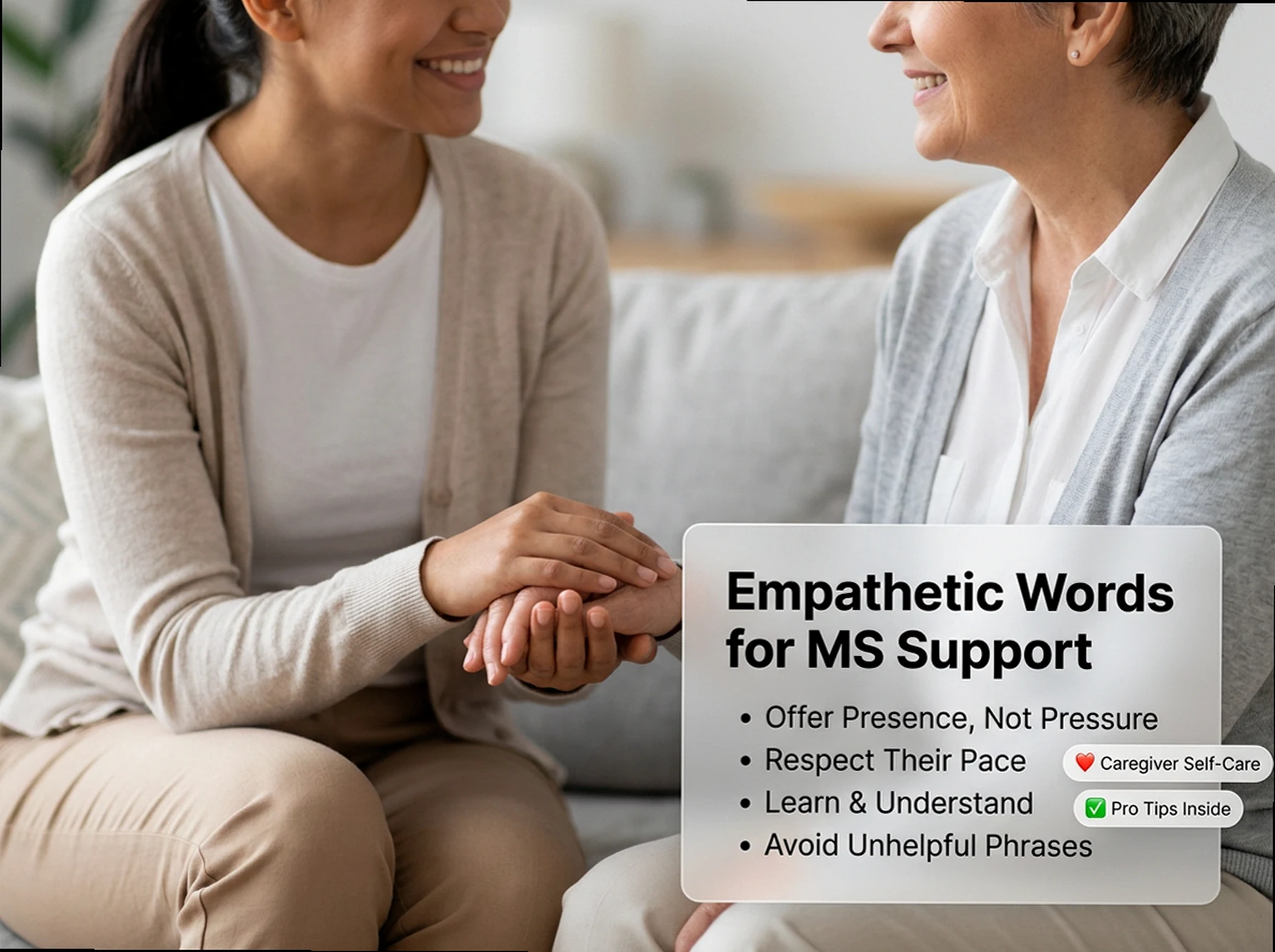

When a cherished individual faces the complexities of Multiple Sclerosis, knowing how to offer steadfast support, both in word and deed, becomes a heartfelt quest. This guide offers thoughtfully curated messages and practical wisdom to help you connect authentically, avoiding common missteps and strengthening your bond.
Editor’s Top Picks: Essential Support Messages
First of all, just to be there for the person and to listen. If they ask for your help, then to please offer it. But otherwise, just be there.
Don’t forget to include them, but also, understand that when you include them, they may or may not be able to attend because of how they’re feeling that day or that hour, because it changes.
Please understand what MS is. It is important for family and friends to read and understand. Do a little research so they don’t have to explain every little detail.
You’re looking good. But how are you truly feeling? If you wish to speak about your symptoms, know that I am here to listen with an open heart.
Never make them responsible for managing your emotions. Seriously, managing the emotions of others is a significant part of dealing with a diagnosis like this.
Cultivating Understanding and Empathetic Connection
To truly stand by someone with MS, a foundational understanding of the condition is paramount, not merely for knowledge, but to truly connect with their lived experience. Empathetic listening, coupled with proactive learning, allows you to offer support that resonates deeply, alleviating the burden of constant explanation and fostering a profound sense of being seen and understood.
Messages for Empathetic Listening and Understanding
- I am doing my best to learn more about MS, so you do not have to carry the burden of explaining every detail. How can I best understand your experience today? 📖
- My dearest, I am here to listen with an open heart. There’s no need for answers, just share what you feel. 🫂
- I understand that each day with MS can bring different challenges. How are you truly feeling in this moment? ✨
- Please know that your symptoms, even when difficult to explain, are valid. I believe you and am here to support you. 💖
- I’m consciously creating space for you to share, without judgment or unsolicited advice. Just tell me what’s on your mind. (´-ω-`)
- How may I best be present for you today? Sometimes, simply being here is the greatest comfort. 🙏
- I’m here for you if you need me, in whatever capacity that may be. My support is unwavering. 🌟
- You are looking well, my dear, but how are you truly feeling beneath the surface? I am listening if you wish to speak of your symptoms. 🌸
- I understand that your MS journey is unique. Rather than comparing, I wish to hear how it is for *you*. Tell me more. 🗣️
- I recognize that your energy levels fluctuate. Please know that if you need to adjust plans, I will always understand. 🗓️
- I am practicing patience and mindful listening. Please take all the time you need to express yourself; there is no rush. (・_・;)
- What are your hopes and dreams, beyond the scope of MS? I want to celebrate all aspects of your beautiful life. 🌈
- I am actively seeking resources to deepen my understanding of MS. Are there any specific sources you find helpful? 📚
- I remember you mentioned [specific symptom/challenge]. How has that been for you lately? I want to be informed. 🤔
- It is perfectly alright if you cannot explain everything; I trust your experience. What matters is that you feel heard. 💝
The Vibe: Supporting a loved one with MS often involves navigating the delicate balance between offering comfort and attempting to “fix” what isn’t yours to solve.
The Play: True empathy lies in creating a sacred space for your loved one to share their experiences without the immediate pressure of finding solutions. Resist the urge to offer unsolicited advice or medical opinions; instead, focus on validating their feelings and simply being present. Listen with your heart, allow for silences, and only offer solutions or practical help when explicitly asked. Sometimes, the most profound support is simply a loving, listening presence.

Words of Affirmation: Offering Comfort and Encouragement
In moments of vulnerability, heartfelt words can serve as a gentle embrace, reminding your loved one of their inherent strength and the unwavering love surrounding them. Tailoring your affirmations to acknowledge their current feelings, rather than dismissing them, ensures your message is a genuine source of comfort and validation.
Heartfelt Affirmations and Encouraging Words
- My love, I am here for you, always, through every twist and turn of this journey. You are never alone. 💖
- Your courage in facing each day is truly inspiring. I see your strength, even in quiet moments. ✨
- Remember this: You are braver than you believe, stronger than you seem, and smarter than you think. I know it. 💪
- I hope you find peace in knowing that resting is not laziness; it is a vital part of your well-being. Take the time you need. 😌
- I recognize that you fight battles unseen, and I want you to know that I honor your journey and your resilience. 🌟
- You are still the wonderful person I cherish, with all your beautiful plans, hopes, and dreams. I celebrate you. 🌈
- I promise to be a steadfast presence, offering unwavering support through all that comes. My love for you endures. 🫂
- Even on the most challenging days, please know that hope is a beacon. Hold onto it, my dear. 🕯️
- I understand that life with MS presents unique limitations, yet I believe in your capacity to find joy and purpose within your hero’s journey. (´∀`)♡
- If you stumble, may you find the grace to make it part of your beautiful dance through life. I’ll be there to catch you. 🩰
- Please never let what you cannot do overshadow the magnificent things you can. Focus on your triumphs, however small. 🏆
- I am here to help calm the storms within, by simply being present and holding space for you. You don’t have to weather them alone. ⛈️➡️😊
- Your resilience shines brightly, reminding us all that hardships often prepare ordinary hearts for extraordinary destinies. 💎
- I will always strive to include you, understanding that your attendance may vary with how you feel. Your presence is a gift, whenever possible. 💌
- It is going to feel less daunting as each day passes, my dear. We face this together, one moment at a time. 👣
- May you always remember that you are capable of amazing things, and I am here to witness and cheer for every step. 💖
- I believe in your strength to find the light, even when hope begins in the dark. I am here to hold that light with you. 💡
- You are not defined by MS; you are a whole, cherished individual. I love you for exactly who you are. 🥰
- Please never hesitate to reach out to me or others; you are surrounded by a community that cares deeply. 🌐
- May you find comfort in knowing that with patience, caring, and empathy, our love for you will always be a guiding force. (っ◔◡◔)っ ♥
Personalize your heartfelt support with these adaptable templates:
Offering Tangible Support: Acts of Love in Action
Offering practical assistance requires a delicate balance of anticipation and respect. Rather than assuming needs, gently inquire about specific ways you can lighten their load. Sometimes, anticipating a need without being asked, such as discreetly tending to a chore, can be a profound act of love, yet always honor their fierce independence and capacity to do things at their own pace.
Practical Ways to Offer Support
- May I prepare a nourishing meal for you to enjoy when you’re not feeling well? No need to cook, just rest. 🍲
- If you find your lawn needs tending, please allow me the joy of mowing it for you. Consider it done. 🌳
- I’ve noticed [specific chore, e.g., ‘dishes’] might be piling up. Would you permit me to take care of them, so you can conserve your precious energy? ✨
- I would be honored to accompany you to your next doctor’s appointment, if you wish for a comforting presence. Just say the word. 🚗
- Let’s preserve our cherished traditions. How about a cozy evening at home with a film or a shared meal, instead of going out? 🎬
- I’m here to help you prioritize your tasks for the day. Together, we can discern what truly needs doing and what can wait. 📝
- Would it be helpful if I assisted with grocery shopping or other errands this week? I’d be happy to. 🛒
- Even a small act of assistance can make a difference. Is there one small thing I could do for you right now? 🤲
- Let’s connect through video calls or social media when you’re feeling up to it. Your presence, even virtually, means so much. 💬
- I can help with transportation or carrying bags if you’re out and about. Please don’t hesitate to lean on me. 🚶♀️➡️🚶♂️
- I understand that some days call for quiet companionship. I’m content to simply be present, without needing to ‘do’ anything. ☕
- Would you like me to research a specific topic related to MS or help organize information you’ve gathered? I can assist with that. 📚
- If you ever feel overwhelmed by social plans, please know there is no pressure. We can always reschedule or adapt. 🗓️
- I’m offering my help with [specific household task, e.g., ‘laundry’ or ‘light cleaning’]. Please let me know if this would bring you comfort. (´∇`)
- Your independence is important, and I respect it deeply. When you do need help, however, please know my offer is always genuine. 💖

Mindful Communication: Avoiding Unhelpful Phrases
Even with the purest intentions, certain phrases can inadvertently cause distress or invalidate a loved one’s experience with MS. Understanding these common communication pitfalls allows us to speak with greater consciousness, fostering an environment of trust where they feel truly heard and respected, rather than judged or misunderstood.
What Not to Say (And What to Offer Instead)
- **Unhelpful**: “But you don’t look ill.” 🤨
**Alternative**: “You are looking well today, my dear. Yet, how are you truly feeling within? If you wish to share about your symptoms, I am here to listen. 💖” - **Unhelpful**: “Have you tried [unsolicited cure/diet]? I heard it works wonders!” 🧪
**Alternative**: “I understand there are many suggestions regarding MS. I trust you and your medical team are exploring the best paths for your well-being. My focus is simply on supporting you. 🌱” - **Unhelpful**: “I know someone with MS, and this happened to them…” 🗣️
**Alternative**: “I know that every journey with MS is deeply personal. Please, tell me how it is for *you*, as your experience is unique and valid. 🌸” - **Unhelpful**: “You’re tired? I get really tired, too.” 🥱
**Alternative**: “I understand MS fatigue is a profound exhaustion, far beyond everyday tiredness. Please know I respect your need for rest and adjustments. 😴” - **Unhelpful**: “Oh no, that’s terrible! I’m so sorry for you.” 😟
**Alternative**: “This must be incredibly challenging, and my heart goes out to you. I am here to offer my steadfast support, however you need it. 🫂” - **Unhelpful**: “My research says you should try…” 📚
**Alternative**: “I respect that you receive professional medical guidance. My role is to be your friend/family, offering love and practical support, not medical advice. 🙏” - **Unhelpful**: “Just spit it out / Hurry up.” ⏱️
**Alternative**: “Please take all the time you need to express yourself, my dear. I am here, listening patiently, with no rush at all. (´-ω-`)” - **Unhelpful**: “But how are you *really* doing?” (asked repeatedly) probing
**Alternative**: “I often think of you. Is there anything on your heart you’d like to share today, or would you prefer to simply enjoy our time together? 🌻” - **Unhelpful**: “You seem so normal/fine today!” 🎭
**Alternative**: “It brings me joy to see you feeling well. I understand that appearances can be deceiving, and I honor the strength you show every day. 🌟” - **Unhelpful**: “Why don’t you try to be more positive?” 😠
**Alternative**: “It’s perfectly alright to feel whatever you feel. My love for you embraces all your emotions, and I’m here to hold space for them. 💖” - **Unhelpful**: “Are you sure it’s not just stress?” 🤦♀️
**Alternative**: “I trust your understanding of your own body and symptoms. Please know that I believe your experience is real and valid. ✨” - **Unhelpful**: “You’re so strong, you’ll beat this!” 💪
**Alternative**: “Your resilience is truly admirable, and I am so proud of how you navigate each day. Please remember it’s also okay to have difficult moments. (っ´ω`)ノ”
On the outside, I may look fine. On the inside, my body is fighting battles you can’t see.
Nurturing the Nurturer: Self-Care for Loved Ones
Supporting a loved one through MS is a profound act of devotion, yet it is vital to remember that your own well-being is equally precious. Nurturing yourself is not selfish; it is the very foundation for sustaining your capacity to give love and care over the long term. Recognize your limits with gentle honesty, and embrace the courage to seek help when needed.
Essential Self-Care for Caregivers and Supporters
- Remember, dear heart, it is not selfish to prioritize your own well-being. Loving yourself allows you to love others more fully. 💖
- You are permitted to ask for help, just as you offer it so freely. Lean on your own network of support; you are not alone in this journey. 🫂
- Should you find yourself feeling ‘stretched too thin,’ please recognize this as a gentle sign of burnout. Your feelings are valid. 😔
- Losing contact with friends or withdrawing from cherished activities can be a sign you need to pause and replenish your spirit. Reach out. 📞
- To prevent burnout, continue to deepen your understanding of MS and what to expect. Knowledge can be a comforting guide. 📚
- Actively seek support from other caregivers or the MS Society in your area. Shared experiences can lighten the load. 🌐
- Allow yourself moments of gentle self-compassion. It is perfectly human to feel overwhelmed; cry it out, then refocus with kindness. (´-ω-`)
- Recognize your own limits, and respect them. Planning ahead can create space for both caregiving and self-care. 🗓️
- Focus on positive moments and events, however small. These bright spots are vital anchors for your spirit. ✨
- If feelings of sadness, hopelessness, or exhaustion persist, please speak with your healthcare provider or a trusted friend. Support is available for you. 🌷
- Remember the wisdom: Patience + Caring + Empathy = Love. Extend this equation to yourself, too. ❤️
- You are doing an incredible job. Take a deep breath, forgive yourself for any perceived shortcomings, and know that tomorrow is a new opportunity. 🌟
Encourage readers to share their personal, heartfelt strategies for supporting a loved one with MS, or their essential self-care practices as a caregiver. This creates a rich, shared resource and fosters a sense of belonging.
Connect & Share: Empowering Hashtags
📚 Jargon Buster
- MS Fatigue
- A profound, overwhelming sense of exhaustion that is not related to activity level and cannot be fixed by a simple nap.
- Invisible Illness
- A chronic condition where the symptoms (like pain, fatigue, or cognitive fog) are not always apparent to an outside observer.
- Emotional Labor
- The invisible work of managing one's own feelings or the feelings of others, often high for MS patients who feel they must 'perform' wellness for their family.