
Capturing Truth with Heart: An Ethical Guide to Documentary Storytelling
For aspiring documentarians, the lens offers a profound opportunity to spark social change. Yet, this power comes with immense responsibility: balancing the drive to capture impactful narratives with an unwavering commitment to ethical practice ensures every story told honors its subjects with integrity.
Ethical Lens: Key Takeaways for Impactful Documentary Photography
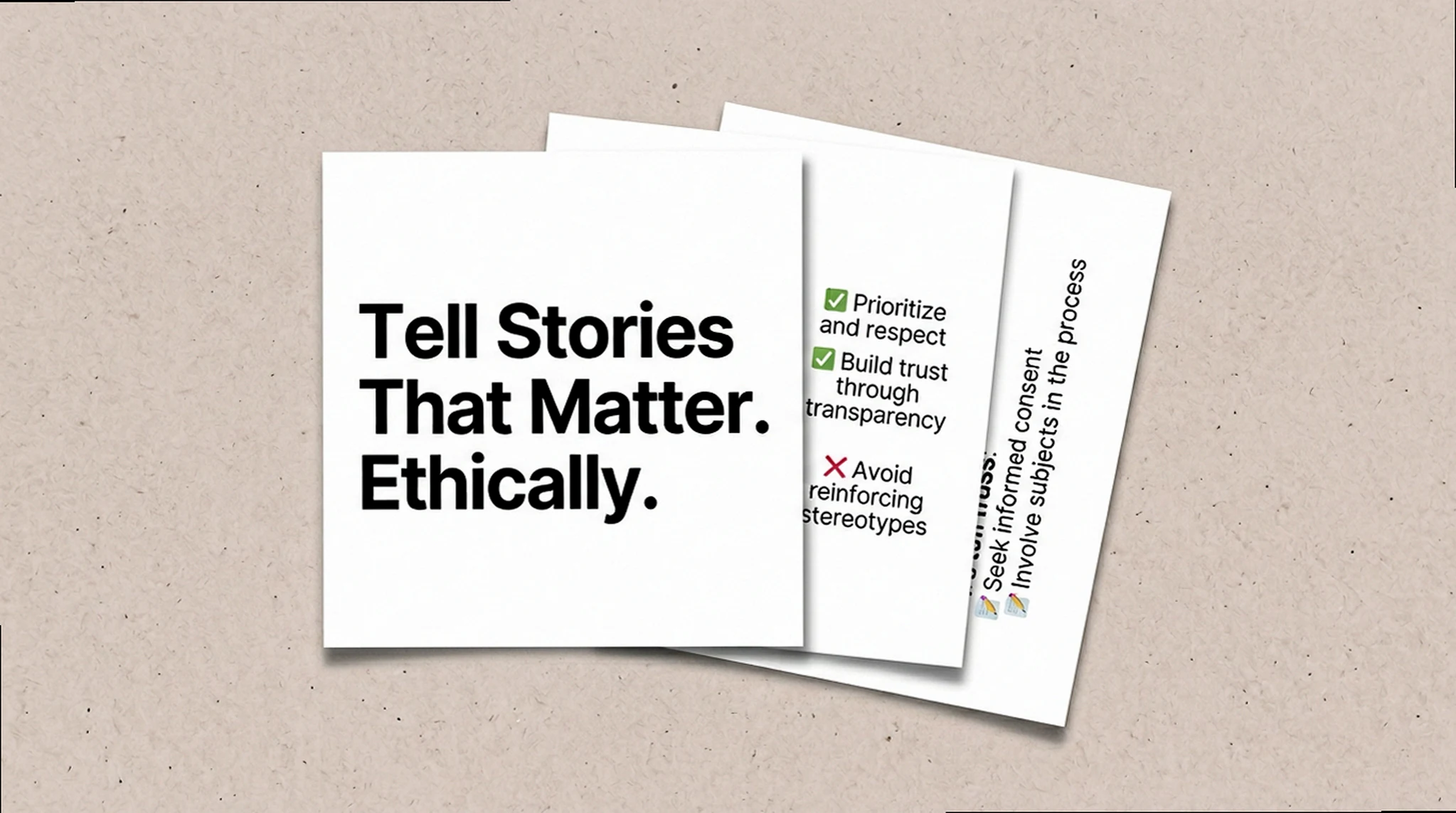
- Prioritize truth and respect: Every frame should uphold the dignity and agency of your subjects.
- Build trust through transparency: Informed consent and clear intentions are the bedrock of responsible storytelling.
- Amplify voices, don’t exploit: Use your camera to empower, not to sensationalize or stereotype.
Curator’s Choice: Essential Wisdom for the Ethical Lens
What I want is the world to remember the problems and the people I photograph. What I want is to create a discussion about what is happening around the world and to provoke some debate with these pictures. Nothing more than this. 🌍🗣️
Photography for me is not looking, it’s feeling. If you can’t feel what you’re looking at, then you’re never going to get others to feel anything when they look at your pictures. ✨💖
A documentary photograph is not a factual photograph per se. It is a photograph which carries the full meaning of the episode. 📖💡
The Heart of the Lens: Foundational Ethical Principles
At the core of truly impactful documentary photography lies a commitment to unwavering ethical principles. Honesty, respect, and authenticity are not merely guidelines; they are the non-negotiable pillars that allow photographers to build profound trust with their subjects and create work that resonates with lasting integrity.
Voices of Vision: Inspiring Quotes on Documentary Photography’s Purpose
- Photography can light up darkness and expose ignorance. ✨ (´∇`)
- Above all, I craved to seize the whole essence, in the confines of one single photograph, of some situation that was in the process of unrolling itself before my eyes. 👁️🗨️
- A great photograph is one that fully expresses what one feels, in the deepest sense, about what is being photographed. 💖 (ノ´ヮ´)ノ*:・゚
- Photographs are a way of imprisoning reality … One can’t possess reality, one can possess images – one can’t possess the present but one can possess the past. 🕰️
- A photographer … gets right inside the story, gets accepted as part of it, stands in the right place at the right time, and presses the shutter. 📸
- The truth is the best picture, the best propaganda. 🎯 (๑•̀ㅂ•́)و✧
- Everything is propaganda for what you believe in, actually, isn’t it? The harder and the more deeply you believe in anything, the more in a sense you’re a propagandist. Conviction, propaganda, faith. I don’t know, I never have been able to come to the conclusion that that’s a bad word. 🗣️
- Any familiarity with photographic history shows that manipulation is integral to photography. ⚠️
- Are we asserting the easy dominion of our civilization over all times and all places, as signs that we casually absorb as a form of loot? 🤔
- There is no doubt that my photographs have a very strong religious overtone, they are like twentieth-century icons. When human beings are suffering, they tend to look up, as if hoping for salvation. And that’s when I press the button. 🙏
- There is one thing the photograph must contain, the humanity of the moment. 🫂
- Photography cannot change the world, but it can show the world, especially when it changes. 🌍🔄
- I try with my pictures to raise a question, to provoke a debate, so that we can discuss problems together and come up with solutions. 💬
- The subject matter is so much more important than the photographer. 🌟
- I’m just interested in people on the edges. I feel an affinity for people who haven’t had the best breaks in society. What I want to do more than anything is to acknowledge their existence. 🤝
- There comes a time when it is not you who is taking the pictures. Something special happens between the photographer and the people he is photographing. He realizes that they are giving the pictures to him. ✨🙏
- The personality of the photographer, his approach, is really more important than his technical genius. 🧑🎨 (´。• ω •。`)
- To me, photography is an art of observation. It’s about finding something interesting in an ordinary place… I’ve found it has little to do with the things you see and everything to do with the way you see them. 🧐
- For me, documentary photography has always come with great responsibility. Not just to tell the story honestly and with empathy, but also to make sure the right people hear it. When you photograph somebody who is in pain or discomfort, they trust you to make sure the images will act as their advocate. 🗣️🛡️
- To me documentary photography means making a picture so that the viewer doesn’t think about the man who made the picture. At its esthetic core is very old tradition in art: naturalism. And its purpose is to document all facets of social relationships. 🌐
Navigating the Frame: Practical Ethical Guidelines
Concrete ethical guidelines are essential in documentary photography to safeguard both subjects and the integrity of the art. By prioritizing informed consent, thoughtful representation, and actively avoiding exploitation, creators uphold the trust placed in them and ensure their powerful narratives contribute positively to the world.
Ethical Lens in Action: Practical Guidelines for Documentary Photographers
- Always seek informed consent and ensure subjects fully understand the purpose and potential use of their images. ✅ (´。• ω •。`)
- Be transparent about your intentions and project goals with subjects to foster genuine trust. 🗣️
- Portray individuals with dignity, actively avoiding intrusive methods or sensationalizing hardship. 🛡️
- Actively work to avoid reinforcing stereotypes or misrepresenting communities. 🚫🎭
- Ensure your images accurately reflect the true situation and context in which they were captured. 📍
- Refrain from digital alterations that change the fundamental reality of the scene. ❌💻
- Verify all facts diligently before publication to maintain unwavering credibility. 🧐
- Prioritize long-term engagement with communities over quick, extractive photographic visits. ⏳ (´∇`)
- Involve subjects directly in the storytelling process, embracing co-creation and community review. 🫂
- Cultivate cultural sensitivity; research local customs and avoid framing that distorts meaning. 🌏
- Continuously question your own motives: Is your goal to educate and inform, or to shock and titillate? 🤔 (⊙_⊙)
- Remember that consent is an ongoing process, requiring re-evaluation if circumstances change. 🔄
- Provide clear and accurate details in captions about time, place, and circumstances to prevent misrepresentation. 📝
- Consider the long-term effects of your work on subjects, balancing visibility with potential risks of exposure. ⚖️
- Where possible, compensate collaborators and actively give back to the communities you document. 💰
Crafting Compelling Narratives: The Art of the Photo Essay
Building a powerful photo essay is an art form that transcends individual shots. Through careful selection and thoughtful sequencing, images are woven together to create a coherent narrative, honoring the truth of a story while guiding the viewer on an emotional and intellectual journey.
Weaving Visuals: Essential Advice for Building Powerful Photo Essays
- Choose a subject you feel deeply about, then immerse yourself fully; meaning will unfold as you work. 🌱
- Work on long-term projects to allow time for genuine understanding between you and your subjects. ⏳
- Let your heart, not just your eye, guide the content of your photographs to capture true emotion. 💖
- If your pictures aren’t good enough, you’re likely not close enough to the story. 🤏
- Saturate yourself with your subject; the camera will almost take you by the hand to capture the story. 🌊
- Approach subjects without preconceptions; allow intuition and exploration to guide your lens. 🚶♀️
- Remember that individual pictures are powerful, but a coherent group of interrelated images tells a deeper story. 🖼️
- Think of your photo story like an article: it needs a strong beginning, contextual middle, and a sense of resolution. 📰
- Sequence your photos thoughtfully, as the order dictates the ultimate meaning and flow of the narrative. ➡️
- Avoid photographing your own preconceptions; instead, discover what is truly unfolding before you. 🧠
Dive into practical editing techniques that can elevate your documentary footage. This video offers valuable insights for aspiring documentarians looking to enhance their visual storytelling.
Beyond the Frame: Interviewing and Crafting Impactful Captions
For documentary photographers, powerful visuals are only part of the story. Skillful interviewing and precise caption writing are essential to provide crucial context, ensure accuracy, and authentically amplify the voices of those they document, transforming images into profound, well-understood narratives.
Mastering the Narrative: Interviewing & Crafting Impactful Captions
- Get physically close to your subjects to capture unique perspectives and tell a more intimate story. 🤏 (๑•̀ㅂ•́)و✧
- Be transparent with your subjects; approach them with your camera visible to make your intentions clear from the start. 🗣️
- Treat captions as the ‘icing on the cake,’ providing essential context that complements your visuals. 🍰
- Start captions with an eye-catching phrase or idiom to draw viewers in and encourage deeper engagement. 🎣 (´∇`)
- Describe what is *actively happening* in the picture using the present tense to convey immediacy. ✍️
- Provide crucial context by clearly answering the ‘who, what, when, and where’ of the moment. 🗺️
- Always seek direct quotes from subjects to answer the ‘why’ and add journalistic depth to your narrative. 💬
- Prioritize accuracy above all else; double-check names and facts rigorously to maintain unwavering credibility. ✅
- Describe details that aren’t immediately obvious in the photo, adding new, valuable information for the viewer. 🤫
- Avoid editorializing or making assumptions about your subjects’ feelings or intentions. 🚫
- Use clear, conversational language; steer clear of jargon, clichés, or overly complex phrasing. 🗣️
- Ensure captions complement the main story without repeating information already provided in the body text. 🧩
- For subsequent photos in a series, simplify descriptions, assuming prior context has been established. 📉
- Always carry a notebook to record names, dates, and key details on location for precise captioning. 📝 (ง •̀_•́)ง
- Cultivate genuine curiosity about your subjects and the profound ‘why’ behind their stories. 🤔
After sharing your documentary photo and its contextual caption, pose a thought-provoking question in your post. Encourage your audience to share their perspectives on the ethical dimensions of the story or the act of documenting it, fostering a respectful and insightful discussion.
📚 Jargon Buster
- Informed Consent
- A foundational ethical practice where the subject fully understands the purpose, potential use, and consequences of their image being captured and shared.
- Naturalism
- An aesthetic approach in documentary work that prioritizes capturing life as it is, without staging, manipulation, or artificial interference.
- Extractive Photography
- A critical term for photography that 'takes' from a community or subject for the photographer's gain without providing value, respect, or long-term engagement in return.